Cookie Dough Fundraiser: How It Works, Profit & Delivery Day
By UnitTally TeamPublished 9 min read
On this page
A cookie dough fundraiser is about the easiest sale a group can pitch. Nobody needs convincing to buy cookie dough, and a tub sells for about $20 to $22. The hard part comes at the end, when hundreds of frozen tubs arrive on one day and every one has to reach the right family before it thaws.
Most of what you’ll find online about cookie dough fundraisers comes from the companies selling them. Those pages lead with the best profit rate and skip the part where you’re standing in a cafeteria full of frozen cases, holding a clipboard.
Note
This is general information, not legal or tax advice. Program terms vary by company and by local dealer, so confirm prices, minimums, and dates with yours.
How does a cookie dough fundraiser work?
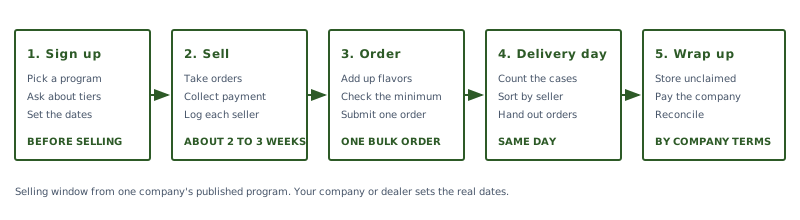
Sellers take orders for a few weeks, the group places one bulk order with the company, and the dough arrives frozen on a single delivery day for families to pick up.
- Pick a program and kick off. Some companies sell to groups directly. Others, like Butter Braid (opens in a new tab) and Otis Spunkmeyer (opens in a new tab), work through local dealers or fundraising partners who handle your account. Then hand out order forms or seller links and set the dates.
- Sell. JustFundraising (opens in a new tab) describes a 2- to 3-week selling window. Sellers take payment with each order, on paper forms or through an online store.
- Place the order. The group adds up every order and submits one total to the company.
- Hand out on delivery day. The order arrives at your school or meeting place, and families pick up what they sold.
- Pay the company. Your group pays the cost of the product and keeps the difference. Otis Spunkmeyer advertises “No upfront costs.” JustFundraising has groups collect buyers’ money first, then pay for the product out of it.
How much money does a cookie dough fundraiser make?
One company, JustFundraising, advertises $6.60 to $12.10 profit on a $22 tub, which is 30% to 55% of the selling price. The top rate usually goes to groups that sell the most. Here is what that range looks like at a few order sizes:
| Tubs sold | At 30% ($6.60 per tub) | At 55% ($12.10 per tub) |
|---|---|---|
| 86 (JustFundraising’s minimum) | $567.60 | $1,040.60 |
| 150 (its free-shipping level) | $990.00 | $1,815.00 |
| 300 | $1,980.00 | $3,630.00 |
JustFundraising’s page doesn’t say how many tubs each tier takes, so ask for the tier table before you set a goal. A small group selling 86 tubs is unlikely to land at the top rate, so plan on the 30% column and treat anything better as a pleasant surprise.
Butter Braid works on a per-item profit instead. Its example shows 400 pastries earning $2,400 at $6.00 profit each, and it notes that per-item profit depends on the dealership.
At the large end, one Ohio school’s PTO ran a school cookie dough fundraiser that sold more than 3,700 tubs in one year for a $20,000 profit, according to a 2018 article in PTO Today (opens in a new tab). That’s about $230 in sales per family, and it covered nearly half of the PTO’s $44,000 budget. It’s a large pre-K through 8th grade school, so treat its result as an upper bound.
Two costs come out of those numbers:
- Card payments. The card fee on one $22 tub is $0.94 at Stripe’s standard rate (opens in a new tab) of 2.9% plus 30 cents. If your payment tool adds its own fee on top, subtract that too. Cash and checks carry no processing fee. Some groups ask buyers to cover the fees instead.
- Shipping. JustFundraising ships free at 150 items or more. Below that, ask what shipping costs, because it comes out of your profit.
How to choose the best cookie dough fundraiser program
The best program for your group is the one whose minimum order and profit tiers fit how many families will sell.
Ask each company or dealer these questions before you sign:
| Question | Why it matters |
|---|---|
| What is the minimum order? | JustFundraising’s is 86 items. It says most companies set theirs at 150 to 300 items or more. Ask what happens if you fall short. |
| What profit tier will we reach? | A 55% headline means little if your group sells at the 30% tier. |
| When does shipping become free? | Shipping comes out of your profit until you reach the free level. |
| Is it frozen or shelf-stable? | Otis Spunkmeyer ships frozen cases. JustFundraising says its dough “can remain at room temperature for more than 7 days,” which takes pressure off delivery day. |
| Does the order arrive sorted by seller? | Butter Braid says “orders will arrive prepacked by seller name.” Others ship one bulk order for you to sort. |
| Is it labeled safe to eat unbaked? | Someone will eat it with a spoon in the car on the way home, so check the label. The CDC warns (opens in a new tab) against eating raw dough unless the label says it’s made to be eaten raw. Put the company’s label guidance on your order form. |
| Is there an online store? | An online store lets buyers pay by card and saves you from retyping paper forms. |
| When do we pay, and how? | Plan to have every buyer’s money collected before the invoice is due. |
What is a Butter Braid fundraiser?
Butter Braid is a frozen pastry sold to groups through local dealers. It runs much like a cookie dough sale: sellers share an online store link or take paper orders, and orders typically come to your group for families to pick up. The online store takes cards and mobile wallets. Profit is set per item by each dealer, so get a quote from yours.
When to collect money for a cookie dough fundraiser
When the order is taken. Collecting up front means you never owe the company for a tub nobody paid for.
The downside is cash and checks riding around in backpacks for weeks. When families turn in money, have two volunteers count it together and log each turn-in. Our cash reconciliation guide walks through that step by step. Deposit into an account in the organization’s name, not a volunteer’s personal account. Our guide to opening a booster club bank account covers how.
If your group credits sales to individual students, be careful what “credit” means. Some schools apply a share of each item’s profit to the seller’s student account. Crediting a sale to a seller for a prize is fine. Moving profit into a family’s own account can put an organization’s 501(c)(3) status at risk. Our guide to tracking fundraiser sales by student explains where that line sits.
How to run a cookie dough fundraiser delivery day
Plan to get every order out the same day, and have the freezer space and sorting help lined up before the truck arrives.
Plan cold storage first. Know where the product goes if pickup runs late. That might be a school freezer, a borrowed chest freezer, or coolers. Butter Braid’s delivery-day guide (opens in a new tab) tells groups to remind sellers and their parents to have storage ready or deliver to customers quickly.
Find out how it arrives. If the company packs orders by seller, your job is checking names off. If it ships one bulk order, you’re sorting every tub yourself, and that takes far more hands, plus at least one person who can read every seller’s handwriting.
Recruit sorters early. At the Ohio school above, thousands of tubs had to be sorted by family within hours, so parents packed them into cases with seventh and eighth graders helping. In PTO Today’s food fundraiser tips (opens in a new tab), one Michigan PTO recruits students from the local middle school’s National Junior Honor Society to sort its pizza kit orders fast.
Time delivery to pickup. The same tips article also describes an Arizona elementary school whose cookie dough arrives by 11 a.m., with parents picking up at 1 p.m. on an early-release day. The shorter the gap, the less time the dough spends thawing in a hallway.
Check the delivery before the driver leaves. Count cases against your order, by flavor, and note anything missing or damaged.
Decide what happens to unclaimed orders. Some won’t be picked up. Plans change, and a few families always miss the window. That Arizona school cleans out a chest freezer ahead of time for leftovers. Tell families the pickup window in advance, by more than one channel, and decide who delivers the leftovers and by when.
The pickup list is easiest to build from a spreadsheet with one row per item: seller, buyer, flavor, quantity, and pickup choice. Sort it by seller for the sorting tables and by flavor for your order total.
UnitTally can produce that list. Each seller gets a link that credits online orders to them. Buyers choose a pickup window or seller delivery when they order, and the order export has one row per item with those same columns. After pickup, you can mark orders collected or delivered to see what’s still out. UnitTally doesn’t order from the cookie dough company, so you still send your totals to your dealer. Logging a cash or check order carries no UnitTally platform fee, and your first 10 card sales carry none either. After that, a card order carries Stripe’s fee plus a capped platform fee, which on a $22 tub is $0.85 on the Free plan and less on paid plans.
Download the free roster and sales tracker
Our roster and sales tracker works in Google Sheets and Excel. It totals units and dollars per seller and per product, and it tracks what each seller has paid and still owes. The product totals give you your order for the company. It has room for 4 products and 28 sellers and comes filled in with a sample wreath sale, so rename the products to your top 4 flavors and total any others from your one-row-per-item sheet. For delivery day, build the pickup list described above.
Free template
Youth Fundraiser Roster & Sales Tracker
Enter your email to join the waitlist, and the spreadsheet downloads as soon as you submit.
youth-fundraiser-roster-tracker-template.xlsxExcel
Your download has started. If it didn’t, download the spreadsheet directly.
Planning your next fundraiser?
Join the waitlist to run it on UnitTally: your group’s own store, sales credited to each seller’s link, and cash and checks logged in the same ledger as card sales.
Cash and checks cost $0 in UnitTally fees. Card sales pay Stripe’s processing fee plus a UnitTally fee of no more than $20 a transaction.