
Fundraiser Cash Reconciliation Spreadsheet & 4-Step Guide
Cash collected by students and parents during a youth fundraiser often sits in paper envelopes for days before reaching the treasurer. When the stack of cash finally lands on your desk, the currency total rarely matches the handwritten order sheets.
Without a structured booster club cash verification form or fundraiser cash reconciliation spreadsheet, tracking down missing $20 bills or unrecorded payments turns into an accounting headache. Understanding how to audit youth fundraiser cash starts with establishing a clear cash envelope reconciliation process. Missing paper slips create audit red flags, frustrate volunteers, and expose your booster club or PTA to financial risk.
This guide details a 4-step reconciliation workflow, shows how to log cash variances in your spreadsheet, and includes a free template to keep your audit trail clean.
This guide presents standard financial controls for non-profit youth organizations. Always verify specific cash handling rules with your state PTA handbook, school district policy, or organization bylaws.
How do you set up a dual-control cash counting process?
Establish dual control by requiring two unrelated adults to count all physical currency together immediately after an event and co-sign a cash verification form before funds leave the site.
Dual control is the single most effective internal control for volunteer organizations. When two individuals count cash together, it protects volunteers against wrongful accusations of theft and ensures that counting mistakes are caught immediately.
Follow these four rules when establishing dual control:
- Require two unrelated signers. The two counters must not be from the same household or family.
- Count in a secure location. Move the cash box away from public areas, snack stands, or chaotic entry tables into a quiet office or closed room before opening envelopes.
- Itemize by denomination. Record the exact count of each bill ($1, $5, $10, $20) and coin denomination on your PTA cash tally sheet rather than writing down a single lump sum.
- Sign before handoff. Both counters must print their names, write the date, and sign the count form before handing the cash box over to the treasurer or deposit custodian.
National organizations such as Parent Booster USA and state PTA groups like the Texas PTA emphasize dual signatures as a standard requirement for annual financial reviews and insurance coverage.
How do you reconcile bank deposits against sales orders?
Match bank deposit receipts directly to signed cash verification forms, logging any cash variance as a separate line item in your master ledger.
When physical cash collected does not match the sum of your member order forms, do not alter order line items or change a seller’s recorded product count. Changing product quantities to force a cash balance creates inventory errors for physical fundraisers like wreaths, popcorn, or spirit wear.
Instead, follow this accounting procedure for cash discrepancies:
- Verify the physical count. Have a second volunteer recount the bills, coins, and checks against the itemized cash verification slip to rule out simple math errors.
- Isolate cash shortages and overages. If cash is short by $10, record a $10 entry under a dedicated “Cash Over/Short” account in your master ledger.
- Keep order records intact. Leave the customer’s order form and the member’s sales credit untouched so inventory and fulfillment remain accurate.
- Log partial seller payments. If a member turns in a partial cash payment (such as $40 toward an $80 order balance), record the $40 credit against their member profile without changing the total product order quantity.
- Attach bank receipts. Staple the bank’s validated deposit receipt to the co-signed cash verification slip and file both in your permanent audit binder.
School accounting guidelines, such as those from California’s Fiscal Crisis and Management Assistance Team (FCMAT), recommend that deposit forms be prepared in duplicate so that bank credit can be cross-verified against student body accounting records.
How to structure a fundraiser cash reconciliation spreadsheet
A fundraiser cash reconciliation spreadsheet organizes physical currency counts, check lists, and order subtotals into automated balance formulas.
When setting up your reconciliation template in Google Sheets or Microsoft Excel, structure the sheet with four distinct calculation blocks:
| Reconciliation Section | Included Line Items | Spreadsheet Formula |
|---|---|---|
| 1. Starting Bank | Initial change provided in cash box | Manual entry (e.g., $100.00) |
| 2. Physical Cash Count | Itemized coins ($0.01 to $1) + bills ($1 to $100) | =SUMPRODUCT(Denomination_Values, Count_Cells) |
| 3. Net Cash Collected | Gross cash count minus starting bank | =Gross_Cash_Total - Starting_Bank |
| 4. Cash Variance | (Net cash + Checks) minus sales order total | =(Net_Cash + Check_Total) - Sales_Order_Total |
If the variance formula calculates a negative result (such as -$10.00), the spreadsheet automatically flags a cash shortage for ledger entry without altering individual order subtotals.
4-step fundraiser cash reconciliation spreadsheet workflow
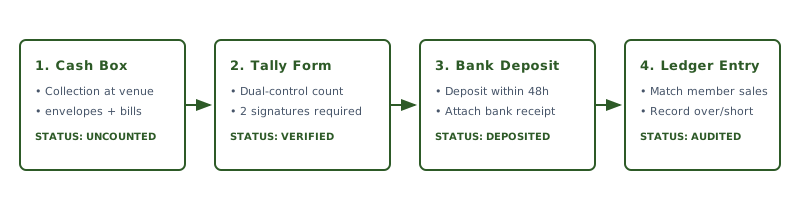
The 4-step paper trail for fundraiser cash reconciliation consists of starting cash box verification, event closeout dual counting, prompt bank deposit, and ledger matching for audit filing.
Step 1: Starting cash box verification
Before your event begins, the treasurer issues a cash box with a known starting amount (the “bank”) for making change. Both the treasurer and the event coordinator count the starting cash together and log the initial balance on the reconciliation sheet.
Step 2: Event closeout and dual count
At the end of the shift or collection day, two volunteers tally all cash, checks, and coins. They subtract the starting cash box balance to calculate net cash collected, itemize checks with an adding machine tape or list, and sign the tally sheet.
Step 3: Prompt bank deposit
Money should never sit in a volunteer’s personal vehicle or home. Scouting America fiscal policies and standard PTA guidelines require prompt deposit into the organization’s official bank account, typically within 24 to 48 hours (or up to 5 business days depending on local bylaws). For independent booster clubs, PTAs, and Scout units, never deposit fundraiser money into a personal bank account or a school district account (school-administered ASB clubs follow their district’s designated deposit account).
Step 4: Ledger matching and audit filing
The treasurer compares the final deposit slip cash count against the co-signed tally form and enters the total into the organization’s accounting system. The physical paper slips are retained for seven years to support the annual internal audit.
Moving from physical tally slips to a roster-aware ledger
Transitioning from physical tally slips to a roster-aware ledger automates seller credit tracking while preserving cash reconciliation audit controls.
Paper verification forms solve physical cash counting, but managing individual member credit across dozens of cash envelopes remains tedious. Treasurers often spend hours transferring cash amounts from paper slips into master spreadsheets to calculate seller awards or individual balances for a booster club, Scout troop, or team.
UnitTally’s free manual tier simplifies this handoff with a roster-aware ledger. You can run your entire fundraiser in manual cash and check mode with $0 platform fees, $0 transaction fees, and zero bank connection required.
Instead of manually logging envelope totals across custom spreadsheets, volunteers and treasurers can record manual cash collections directly against an individual seller’s profile. The system updates sales totals, tracks pending payments, and generates distribution-sorted summaries while preserving a clean audit record for every dollar collected. Our fundraiser fee calculator lets you compare manual cash tracking against card processing side-by-side.
Download the cash box reconciliation template
Use our free cash reconciliation spreadsheet and printable count slip to standardize cash counting for your next concession stand, wreath sale, or spirit wear fundraiser.
Free download: Cash Box Reconciliation Spreadsheet
Enter your email to join the early access waitlist and get instant access to the template file.
Start your next fundraiser
Join the waitlist. Launch your next wreath, cookie, or spirit wear sale with capped per-transaction fees.