
How to Open a Bank Account for a Booster Club
You inherit one of two situations. Either there is an account with the previous treasurer’s name on it and you cannot sign on it, or there is no account at all and the concession cash is sitting in an envelope in someone’s kitchen drawer.
Those are two different jobs. Opening a bank account for a booster club means gathering documents the club may not have, and the list is longer than it looks. Show up missing one and you go home to book another appointment. Getting your name onto an account that already exists is the shorter job, handled with a new signature card and the minutes that elected you, not a new application.
This guide covers both, plus whose tax ID goes on the account. If your club already has an account and you only need to be added to it, skip ahead to changing the signers.
This is general information, not legal or tax advice. Bank requirements vary by institution and PTA rules vary by state, so confirm the specifics with your bank, your state PTA, and a tax professional if you are unsure.
What documents do you need to open a booster club bank account?
Two things are effectively universal: a tax ID for the organization, and government-issued photo identification for whoever will sign. Wells Fargo, for one, asks for two forms of ID per signer. Everything past that depends on which bank you walk into.
The variable part is proof that your organization exists. A bank wants a document showing the club was formed, when, and under what name. If your club is incorporated, that is your articles of incorporation. If it has run for years on nothing but a checkbook and a tradition, with no incorporation papers in a drawer anywhere, you need something else.
Wells Fargo publishes a list for exactly this case. It accepts a “Business License, Fictitious Name Certificate, Fictitious Name Statement, Certificate of Assumed Name, Organization/Association Articles or Bylaws, Certificate of Formation, Certificate of Organization, Statement of Organization, Certificate of Good Standing, Certificate of Registration.” If your club has none of those, the same page offers a fallback: “please provide governing documentation for your entity, such as meeting minutes documented on business letterhead,” as long as those minutes show the meeting date, the name, the address, and the date the group was established. That is one bank’s policy, not a universal rule, but it shows what a bank is trying to establish.
Two more details from that same page are worth checking before you drive over. Wells Fargo asks for a primary and a secondary ID per signer, and it will not accept a mailing address: “A physical address is required; Registered Agents, Virtual Addresses, and PO/Commercial mailboxes are not acceptable.”
Other banks draw the line differently. U.S. Bank’s nonprofit checking page asks for “Articles of Incorporation, Articles of Organization, or a charter or a similar legal document that indicates when your company was formed,” and does not publish the unincorporated fallback that Wells Fargo does. Chase publishes a general business list and routes nonprofits to a relationship manager instead of a public checklist.
So call first. Ask the branch which formation document they will take, whether every signer has to appear in person, and what they need to see for a board resolution. Then build your folder:
- The club’s EIN, and the IRS letter confirming it if you have it.
- A formation document: articles of incorporation, or bylaws, or dated meeting minutes on letterhead.
- Minutes of the meeting that elected your officers and authorized the account, naming who may sign.
- Primary and secondary photo ID for every signer.
- A physical street address for the organization.
Ask about cash handling before you pick the bank
Booster clubs and PTAs deposit cash, and cash is where account fees hide. U.S. Bank’s nonprofit account has no monthly maintenance fee. It allows 1,800 free transactions a year and charges $0.50 for each one after that, plus 300 free cash deposit units per calendar year and $0.35 per unit beyond that.
If you run concessions every Friday night, that cash deposit cap is the number that matters, not the monthly fee. Ask each bank for its cash deposit limit and its per-item fee past that limit, and ask what it takes to open the account. U.S. Bank’s nonprofit account has no minimum balance requirement but needs $25 to open. Credit unions are worth a call too. One regional credit union markets a booster club checking product specifically, with no monthly fee, though membership rules limit who can open it.
Does a booster club need its own EIN?
Yes. A booster club needs its own EIN to open an account in the club’s name, and the account should never run on a volunteer’s Social Security number as its tax ID. Tying club money to one person’s personal tax profile creates problems that outlast that person’s term.
The online EIN application is free and issues the number immediately once approved. A few IRS rules shape how you fill it out:
- The application names a “responsible party,” and the IRS is explicit that “Your responsible party must be a person, not an entity.”
- That person supplies “the Social Security number or taxpayer ID number of the responsible party in control of your business or organization.” The application requires an SSN. That is a different thing from putting an SSN on the account itself, which is what to avoid.
- “You can apply for only 1 EIN per responsible party per day,” which matters if one parent is setting up more than one group.
- Do not list a convenient stand-in, like a school employee who does not control club funds. The IRS bars nominees as the responsible party, and a mistaken entry gets corrected with Form 8822-B.
If your group is a scouting unit rather than an independent booster club, the answer changes: which EIN a chartered unit uses depends on how the unit is registered. That case is covered in our guide to scout unit EINs and bank accounts.
If the EIN letter is lost
EIN letters go missing. They live in a banker’s box handed from treasurer to treasurer, and paper does not survive that well. The IRS offers two ways to get written proof of the number, and the online one is worth trying first.
The IRS EIN page notes that “Eligible Business Tax Account users can download a digital CP575, Employer Identification Number Verification Notice in BTA.” If your club does not qualify for that, the phone route gets you Letter 147C, EIN Previously Assigned, which serves the same purpose. The same page gives the number as 800-829-4933, Monday to Friday, 7 a.m. to 7 p.m. local time.
An EIN is not the same as 501(c)(3) status
No. State incorporation, an IRS EIN, and 501(c)(3) status are three separate things from three separate sources. Of those three, a bank asks only for the EIN. It does not ask for incorporation papers or a 501(c)(3) letter.
They are easy to run together, so it is worth separating them before you call the bank.
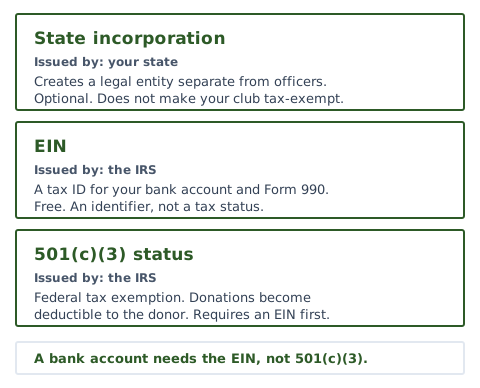
Incorporation happens at the state level and creates an entity legally distinct from the parents who run it. An EIN comes from the IRS and identifies that entity for banking and tax filing. 501(c)(3) recognition also comes from the IRS, on a separate application, and is what makes donations deductible to the donor.
A group can be unincorporated, hold an EIN, and run a bank account without ever filing for 501(c)(3). There are trade-offs. Without incorporation, officers carry more personal liability. Without 501(c)(3), a business that sponsors your team cannot deduct the gift. But none of that blocks the account.
If your club does hold 501(c)(3) status, the filing does not end there. The IRS states that “If an organization fails to file its required annual return or notice for three consecutive years, the IRS automatically revokes its tax-exempt status.” A small organization can regain it retroactively by applying within 15 months of the revocation letter. Ask the outgoing treasurer which returns were filed.
How does a PTA open a bank account?
A PTA follows the same bank process, with one thing to settle first.
Every PTA must acquire an EIN, in National PTA’s words. That number “should be used for bank accounts and will be required for filing IRS Form 990.” Before applying for one, though, “Check with the state PTA office or the previous treasurer for the PTA’s EIN.” Filing a duplicate when one already exists creates its own mess, and the guidance is explicit that “some state PTAs secure the EIN for their PTAs.”
Tax-exempt status depends on your state. Per the same National PTA guidance, “Some state PTAs have secured from the IRS a group or blanket federal income tax exemption under Section 501(c)(3)… this group or blanket exemption applies to the state PTA’s local units and other constituent bodies. In other states, each local PTA must secure tax exemption for itself from the IRS.” Your state PTA office knows which category you are in. A group exemption covers the tax status, not the EIN. Your unit still needs its own number for its own account.
One rule holds regardless of state. A PTA is its own legal entity, not part of the school. On keeping the money separate, National PTA is firm: “PTA funds should never be deposited into a personal account, school account, or the account of any other organization or group.” The same guidance adds that “PTAs should not share their EIN numbers, their sales tax exemption or their banking details with schools, principals or school districts.” So when someone suggests the PTA can just run on the school’s tax ID, the sourced answer is no.
Why the bank asks for the treasurer’s Social Security number
Because federal banking rules require the bank to identify one human being who controls the account, and the regulation names the treasurer by title.
Under 31 CFR 1010.230, a bank has to identify a “single individual with significant responsibility to control, manage, or direct a legal entity customer, including: (i) An executive officer or senior manager (e.g., a Chief Executive Officer, Chief Financial Officer, Chief Operating Officer, Managing Member, General Partner, President, Vice President, or Treasurer).”
To a first-time treasurer, this reads like taking on personal liability for club revenue. It is not. The bank is verifying the identity of a control person, which is separate from whose tax ID the account runs on. The account still runs on the club’s EIN.
There is a limit worth knowing if your club never incorporated. The rule relieves nonprofits of the 25 percent ownership test, but only for “Any legal entity that is established as a nonprofit corporation or similar entity and has filed its organizational documents with the appropriate State authority as necessary.” An unincorporated club may not land inside that carve-out, so do not assume the bank will skip the ownership questions.
How to change bank signers when officers change
Changing signers is its own procedure, and a shorter one than opening an account. You update the signature card, and you bring the minutes of the meeting that elected the new officers.
National PTA puts the transition step plainly: “Change the signatures on your PTA’s bank accounts. You will want to be sure previous officers no longer have access to your accounts. A transition letter from the outgoing treasurer or president to the bank may be necessary to enact this change. Also, make sure the bank has your PTA’s EIN on file, rather than an individual’s social security number.”
Three more things belong on the handoff list.
File Form 8822-B if the responsible party changed. If the outgoing officer was named as the responsible party on the EIN application, this is a federal filing with a deadline, not a formality. The instructions for Form 8822-B state that “Changes in responsible parties must be reported to the IRS within 60 days.” The clock starts at the change, not at the point someone thinks to ask about it.
Get the books reviewed at the handoff. National PTA advises that “Books should also be audited if a financial officer resigns… before the new officer assumes his or her duties.” Starting with someone else’s unreviewed numbers means inheriting their errors as your own.
Check whether school employees can sign at all. If your club elected a coach, a band director, or a faculty sponsor as an officer, check the district’s policy before you add them to the account. “Many school districts do not permit employees to be signers on the bank account, even if they are association officers,” per Texas PTA, which adds: “Check with your school district about their specific volunteer policies.”
Two signatures on a check do less than you think
A two-signature rule in your bylaws is worth having. Just do not treat it as a control that the bank enforces. California State PTA says it directly on its banking page: “Most banks do not verify a second signature received on PTA checks.”
That page offers two responses: move to a bank that will enforce the requirement, or keep the two-signature rule in your bylaws and back it with review. The review is the part that works. Have someone who cannot sign checks read the monthly statement. National PTA frames the same control as making sure “all bank statements and bank reconciliations are reviewed each month by someone who does not have access to the bank account or authority to sign checks.”
Signature rules themselves are not uniform. California State PTA calls for “At least three elected officers, two of whom must be the president and the treasurer” on the account, and says that “The authorized check signers must not be related by blood or marriage or reside in the same household.” Texas PTA instead leaves the count to local bylaws, advising that “PTAs should adopt a check-signing policy or include it in the standing rules to determine the number of signatures required, amount thresholds, and other stipulations.” Read your own bylaws before you assume.
The gap between one treasurer and the next
Between the outgoing treasurer finishing and the new signature card clearing, there is a gap. Money still arrives during that window. Envelopes come back from a fall sale, someone drops off concession cash, and none of it can be deposited yet.
Keep a record anyway, and keep it somewhere that is not one volunteer’s personal spreadsheet. UnitTally runs a fundraiser ledger in manual mode with no bank connection and no payment processor, so cash and check payments can be logged against the member who collected them while the bank paperwork is still moving. Manual entries are $0 on every pricing tier. Taking online card payments later is a separate step. It needs a connected payment account, which requires the EIN and a bank account in the organization’s legal name. That path costs Stripe’s processing fee plus a capped platform fee.
What a cash-only fundraiser nets before the account opens
The fundraiser calculator treats cash and check orders separately from card orders, so you can see what a cash-only sale nets now and what changes once the account is open and you can take cards.
Start your next fundraiser
Join the waitlist. Launch your next wreath, cookie, or spirit wear sale with capped per-transaction fees.