
How to Run a Wreath Fundraiser: Timeline, Profit & Pickup
A holiday wreath fundraiser looks simple from the outside. Families take orders, and a few weeks later people drive away with wreaths. The coordinator sees the other side. There’s a stack of order forms, a supplier deadline that doesn’t move, cash and checks piling up, and one afternoon when every order has to reach the right family.
Learning how to run a wreath fundraiser mostly means learning the calendar and the math. Order too late and you miss the supplier cutoff. Order too many and the extras eat your profit. Lose an order form and pickup day turns into a line of people asking where their wreath went.
This guide is for whoever is running the sale, whether that’s a booster club, a PTA, or a scout unit. It covers what a wreath actually nets, when the supplier needs your order, how to set up the tally sheet, and how to run pickup day.
This is general information, not legal or tax advice. Supplier terms, sales tax rules, and organization policies vary, so confirm the specifics with your supplier, your state, and your school or parent organization.
How much profit does a wreath fundraiser make?
In one supplier’s worked example, a $30 wreath leaves $6.81 for a cash sale and $5.64 for a card sale.
Suppliers advertise bigger numbers. Mickman Brothers says, “Most groups earn between $8 and $10+ profit per item.” The worked example on its program page comes out lower. Here it is, with a card-payment column added.
| Line | Cash or check order | Card order |
|---|---|---|
| Price to the buyer | $30.00 | $30.00 |
| Wreath (wholesale) | -$19.20 | -$19.20 |
| Shipping (Iowa zone) | -$3.64 | -$3.64 |
| Delivery bag (optional) | -$0.35 | -$0.35 |
| Card processing (2.9% + 30¢) | $0.00 | -$1.17 |
| Left for your group | $6.81 | $5.64 |
Mickman’s page labels its example profit as $6.50, but the cost lines add up to $6.81 at $30. Your group pays shipping, and the amount depends on how far you are from the supplier, so your result will differ. The card line uses Stripe’s standard online rate of 2.9% plus 30 cents. If your payment tool charges a fee on top of that, subtract it too.
Two things change the result most:
- Your price. Suppliers print a suggested price, but groups set their own. At $32, the cash column above becomes $8.81.
- Unsold wreaths. In this example, each wreath you order and can’t sell costs $23.19, which takes back the profit from more than three cash sales.
Some suppliers skip the bulk order entirely. Lynch Creek Farm, for one, ships each wreath straight to the buyer and pays the group 10% of sales, with “no collecting money, and no products to distribute.” That’s a smaller share than a bulk program keeps. On a $50 order, 10% is $5, and buyers pay the supplier’s retail price plus shipping. In exchange, there’s no pickup day and no leftover stock. For a small group without volunteers to spare, that trade can be worth it.
When do you have to order wreaths for a fundraiser?
The suppliers we checked want your final order between late October and mid-November, with delivery from mid-November into December.
A few published examples:
| Supplier or program | Deadline | Delivery |
|---|---|---|
| The Glacier’s Edge sale, one organization’s 2026 program | Orders by Oct 28 | Pickup Nov 10 to 11 |
| Mickman Brothers, traditional | Final order Nov 1 | Ask the supplier |
| Sherwood Forest Farms, before Thanksgiving | Final order Nov 3 | Nov 16 to 24 |
| Sherwood Forest Farms, after Thanksgiving | Final order Nov 9 | Nov 30 to Dec 7 |
| Three Rivers Fundraising, direct ship | Register by Nov 10 | Shipped to buyers |
| Mickman Brothers, late order | Final order Nov 15 | Second week of December |
Treat these as examples. Some program pages don’t list a year, so confirm this season’s dates with your supplier.
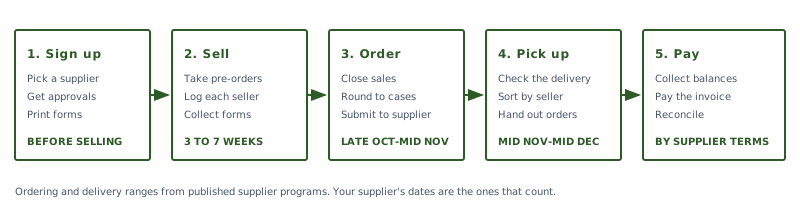
Work backward from the supplier date:
- Final order date. Put it on the calendar first.
- Your internal cutoff. Give yourself a few days before the supplier date to chase missing forms and add up the totals.
- Selling window. Published windows vary. The Glacier’s Edge sale runs from September 10 to October 28, about seven weeks. Three Rivers asks groups to sell between October 15 and December 1.
- Approvals and forms. Finish these before selling starts. Print one order form per seller, plus a few spares for the ones that get lost.
If you run the sale for a scout troop or pack, there’s an extra step. Scouting America’s Unit Money-Earning Application requires written council approval at least 14 days before the unit commits to a sale, unless the council itself runs the sale. Girl Scout councils also require approval, and one council’s rules limit troop money-earning to dates outside the council’s product sales. Check your council’s version.
Should you order extra wreaths beyond what you pre-sold?
Usually no. Order what families actually sold, and let any extras come from rounding up to full cases.
Some suppliers ship in full cases. Mickman, for example, has no minimum order but ships “in full case quantities,” so your order may round up on its own. Those few extras usually cover a walk-up sale or an order that arrives after the cutoff. Anything past that is money spent on a product that dries out within weeks.
How to set up a wreath fundraiser order form and tally sheet
A good tally sheet tells you who sold each wreath, who bought it, and whether it’s paid.
Paper order forms tend to break in the same few ways. The seller’s name is missing, the handwriting can’t be read, or nobody noted whether the check came in. One troop’s sale rules even turn away checks made out to the wrong payee. Give each of these its own field on the form, so nobody can skip it:
- Seller name at the top, filled in before the form goes home.
- Buyer name, phone, and email on every line, so you can reach them before pickup.
- Item, size, and quantity in columns that match the supplier’s product list.
- Payment method and amount, plus whether it’s paid in full.
- Who checks go to, printed exactly.
Then keep one wreath sale spreadsheet with a row per order. Add columns for seller, product, quantity, amount due, amount paid, and picked up. A pivot table by product gives you the supplier order. One by seller gives you each seller’s totals and the pickup list.
If your group rewards top sellers, be careful what “credit” means. Crediting a sale to a seller for a prize is fine. Moving profit into a family’s own account is not, and it can put an organization’s 501(c)(3) status at risk. Our guide to tracking fundraiser sales by student covers where that line sits.
Can buyers cancel or change a wreath order after the cutoff?
Not easily, because the supplier order is already placed. Decide the policy before selling starts, and print it on the order form.
Some options:
- Late orders come out of the case-rounding extras, first come, first served.
- Cancellations after the cutoff mean resale. The wreath is already on the truck, so the buyer finds someone to take it or the group sells it at pickup.
- Moving an order to another seller goes on the master sheet, so the sale credit and the payment follow it.
Some programs give you a short grace period. The Glacier’s Edge sale takes orders by October 28 and allows additions and edits until November 5. Ask your supplier whether it has one.
Should you collect money at order or at pickup?
Collecting at order means every pre-sold wreath is paid for before you order it. Collecting at pickup keeps the form simpler, but you owe the supplier even if a buyer never shows.
Collect when the order is taken. The money is in hand before the supplier’s invoice arrives. In exchange, you handle refunds when a buyer cancels, and cash sits in envelopes during the selling window.
Collect at pickup. Buyers can order without paying, and nobody holds money for weeks. Any buyer who never shows leaves your group covering that wreath’s full cost.
Whichever you choose, put it on the form. When families turn in cash, have two volunteers count it together and log each turn-in, as our cash reconciliation guide walks through step by step. Keep payments out of volunteers’ personal Venmo accounts, too. Money belongs in an account in the organization’s name, and our guides to opening a booster club bank account and to scout troop EINs and bank accounts cover how to set one up.
Also check your supplier’s payment terms. Mickman, for example, bills after the sale, and the group pays once the invoice arrives. The Glacier’s Edge sale wants payment by December 4. Plan to have every balance collected before your invoice is due.
Do you charge sales tax on wreaths?
It depends on your state, and some states exempt nonprofit fundraising sales up to a set number of days or dollars a year.
Wisconsin is one example. Its nonprofit sales tax publication has two tests: sales on 75 days or fewer a year, or $50,000 or less in receipts. The publication uses a wreath sale as an example. Say a troop takes orders from October 1 to November 1 and delivers on December 15 and 16. Only the two delivery days count toward the 75-day test. Check your state revenue department’s page on fundraising sales before the season starts.
How to run a wreath fundraiser pickup day
Pickup day goes smoothly when the wreaths are sorted before the first car arrives.
Check the delivery. Count it against your order before you sign, and photograph anything damaged. Claim windows can be short. Mickman’s is 5 days from delivery.
Sort before you open. Group the wreaths by seller or by pickup time, using your master sheet. Print a list for each group so volunteers can check names off as orders go out.
Stagger pickup windows. One pickup window means one long line. Two or three windows across a weekend let families pick a time and keep the parking lot manageable. In UnitTally, buyers choose a pickup window when they order, so each family has its time slot before pickup day. Logging a cash or check order carries no UnitTally platform fee. A card order carries a capped platform fee on top of the Stripe fee in the table above. On a $30 wreath, that’s $0.53 to $1.05, depending on your plan.
Keep unsold greenery cool. Decide ahead of time who delivers unclaimed orders. One option is handing them to the seller’s family to drop off. For anything left over, Mickman advises that “evergreens do best in cool, dry places.” Lynch Creek Farm’s care guidance puts a fresh wreath at 6 to 8 weeks outdoors in a cold climate and 4 to 6 weeks in a warm one. Indoors, it lasts about 3 weeks with regular misting.
Download the free fundraiser tally sheet and sales tracker
Our roster and sales tracker works in Google Sheets and Excel. It has room for 4 products and 28 sellers, and it comes filled in with a sample wreath sale. It totals units and dollars per seller and per product. It also tracks what each seller has paid and still owes. The product totals give you your supplier order. For the pickup list, use the order-by-order sheet described above.
Free download: Youth Fundraiser Roster & Sales Tracker
Enter your email to join the early access waitlist and get instant access to the template file.
Start your next fundraiser
Join the waitlist. Launch your next wreath, cookie, or spirit wear sale with capped per-transaction fees.