Snap! Raise & Vertical Raise Fees on $10,000
By UnitTally TeamPublished 12 min read
On this page
- How much do Snap! Raise and Vertical Raise take from a $10,000 fundraiser?
- Why do students push back on Snap! Raise and Vertical Raise contact quotas?
- Are Snap! Raise and Vertical Raise fees worth it, and what are the alternatives?
- How to run a four-week team drive without paying a 20% cut
- Calculate what a 20% fee costs your fundraiser
When a local fundraising rep pitches your coach or athletic director, the offer sounds hard to turn down. There are no upfront costs and no cookie dough to sort in the gym parking lot. The rep even runs the kickoff meeting at practice. Athletes enter 20 or more contacts into an app, and the software sends reminders for four weeks.
The catch appears on the settlement sheet. Snap! Raise and Vertical Raise fees usually run around 20% of the total raised. Some teams report contracts that increase this cut if the roster misses participation quotas. On a $10,000 campaign, a 20% cut means $2,000 leaves the program before a single uniform or bus is paid for.
Note
Rep-managed platforms quote custom rates by school, sport, and contract. As of October 2026, the figures below come from vendor help pages, competitor comparison pages, a public school district’s vendor list, a team forum, and student newspapers. Check your written agreement for your exact split and quota rules.
How much do Snap! Raise and Vertical Raise take from a $10,000 fundraiser?
With a 20% fee (Snap! Raise’s published split and a commonly reported Vertical Raise split), the platform takes $2,000 from a $10,000 campaign. Your team keeps $8,000 before card processing charges. Reported cuts on donation drives range from 15% to 30% ($1,500 to $3,000) based on the contract, fundraiser type, and checkout settings. Product fundraisers operate differently because part of each sale pays for the product.
Neither company posts a single flat rate. Local territory reps set terms for each program:
- Snap! Raise: The official pricing FAQ (opens in a new tab) states there is no startup cost and groups “keep 80% of the total dollars raised,” with the fee deducted at close.
- Vertical Raise: Its pricing breakdown (opens in a new tab) states your split depends on the fundraiser type (donations versus popcorn, discount cards, or a-thons), rep involvement, and prize package.
- Card fees and checkout prompts: Snap! Raise processes cards through Stripe (opens in a new tab), but its pricing page doesn’t specify if card processing comes out of your 80%. Competitor Schoolfundr reports (opens in a new tab), citing June 2024 pricing, that Snap! Raise has asked donors to cover a 4% processing fee by default. Competitor 99Pledges says (opens in a new tab) Vertical Raise prompts donors for a 15% tip. Ask your rep in writing.
- One district’s vendor list: Colorado Springs School District 11 (opens in a new tab) lists Snap! Mobile, Snap! Raise’s parent company, at about 80% kept and Vertical Raise at 50% to 85% kept. Two other vendors on the list, Adrenaline and SupportFund, leave groups with 80% to 85% on donations and 40% on products.
Participation quotas can push the fee above 20%
The 80/20 split often relies on how many roster members upload contacts and secure gifts. Snap! Raise keeps its contract schedule private, so teams provide most of the available information. A FIRST Robotics forum poster wrote in a 2017 Chief Delphi thread (opens in a new tab) that Snap! Raise takes 23% to 30%. The lower rate applied only if 70% of the team entered 20 emails and received one donation. 99Pledges’ comparison guide (opens in a new tab) describes a similar 70% rule. Check the sliding-scale clause in your contract before signing.
Snap! Mobile’s Snap! Raise Guarantee disclosure (opens in a new tab) works from the other direction. It promises pre-approved programs at least the same net proceeds as a prior comparable campaign, with conditions: 95% of the roster must send 20 delivered emails, achieve a 40% open rate, and bring in one gift. The program also cannot run a competing fundraiser in the four weeks before or during the drive.
Payout timing: a mailed check can take two and a half to six weeks
Expect two and a half to six weeks for a mailed check. The platform collects funds first and deducts its split at settlement. Per Snap! Raise’s check delivery FAQ (opens in a new tab), paper checks are issued 8 to 14 days after close. USPS First-Class delivery then takes 7 to 10 business days, and sometimes up to 20. An expedited check costs $25.
Direct deposit is faster. With ACH direct deposit (opens in a new tab) set up during the campaign, daily or weekly deposits send about half of the gifts from the prior day or week. Groups can also add bank details up to two weeks after close and take a lump sum when the campaign is finalized, which can take up to a week. Otherwise, payout defaults to a mailed check.
Why do students push back on Snap! Raise and Vertical Raise contact quotas?
High school athletes and performers push back on rep-run drives because contact quotas turn their personal contacts into an automated marketing list. Snap! Raise asks each student for 20 emails. Vertical Raise asks for 20 emails and 10 texts. Student journalists question giving up 20% to 25% of each relative’s gift, and one called the prize incentives cheap.
Three student newspaper columns illustrate the roster’s view of quotas:
- East Lansing High School (Portrait, Michigan, December 2024): In “Vertical Raise needs to go” (opens in a new tab), dance team member Sasha Pager wrote that sending 20 emails and 10 texts to friends and family “can be incredibly awkward.” East Lansing’s football team raised $17,812 on Vertical Raise and kept $14,249 after the 20% fee. The band and orchestra skipped Vertical Raise, raised $3,000 less, and still kept more.
- Lake Oswego High School (Lake Views, Oregon, December 2019): In “Snap!Raise Sucks” (opens in a new tab), Carter Daniels described a rep visiting practice in a branded beanie, offering cheap prizes like a headband for five donors, and requiring 20 emails per athlete. Daniels argued giving up 23% for automated emails made little sense when athletes could write personal notes or sell pies.
- West Covina High School (WCHS Insight, California, October 2016): In “Online Fundraisers: Revolutionary or Ripoff?” (opens in a new tab), Nicholas Brandt questioned mandatory participation when a platform takes $2.50 of a $10 gift that could go straight to the club, with help from the Associated Student Body office.
Some parents view it differently. In the comments on the East Lansing piece, one parent wrote that giving up 20% was worth avoiding hundreds of volunteer hours delivering pizza kits and wrapping paper.
Are Snap! Raise and Vertical Raise fees worth it, and what are the alternatives?
Yes, if your team lacks parent volunteers. The 20% covers an in-person rep kickoff, four weeks of automated reminders, and prizes. If a treasurer or team parent can run the kickoff and the follow-up, self-serve alternatives keep $1,350 to $2,000 more on a $10,000 campaign.
Snap! Mobile makes its own case in “The Cost of ‘Free’ Fundraising” (opens in a new tab). It argues some “free” platforms sell user data, pool donations in one account, leave the outreach to you, and offer no dedicated rep. This is a paid competitor’s view, so weigh it against the costs in the tables below.
Coaches pick Snap! Raise and Vertical Raise for two primary reasons:
- The rep forces turnout. Handing a passive link to 30 teenagers rarely works. A rep at practice while players enter contacts, followed by four weeks of automated reminders, drives gross volume. A self-run drive that skips that push can raise less.
- District approval. Districts can restrict outside platforms. Colorado Springs District 11 approves fundraising partners individually, each with an active Fundraising Privileges Memorandum. It lists Snap! Mobile and Vertical Raise as partners, marks GoFundMe and PayPal as unapproved, and says online fundraisers otherwise go through My School Bucks.
Scenario 1: On 200 gifts of $50, self-serve tools keep $9,350 to $10,000
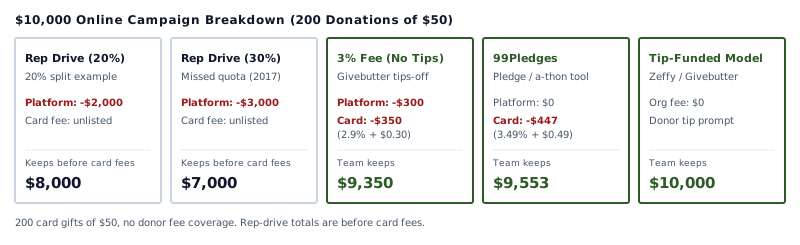
Here is what reaches your bank account on a $10,000 campaign of 200 online gifts of $50 when no donor covers fees at checkout:
| Platform or method | Platform fee | Card processing fee | Team keeps | What to know |
|---|---|---|---|---|
| Snap! Raise / Vertical Raise (20% split example) | -$2,000 | Not published | $8,000 before card fees | Rep runs the kickoff; four weeks of email and text reminders. |
| Snap! Raise (missed quota, 30% reported in 2017) | -$3,000 | Not published | $7,000 before card fees | One forum report of the rate when the roster missed its quota. |
| Givebutter (opens in a new tab) (tips off, 3% platform fee) | -$300 | -$350 (2.9% + $0.30) | $9,350 | No tip prompt; 3% platform fee plus Stripe fee (opens in a new tab). |
| 99Pledges (opens in a new tab) (pledge / a-thon) | $0 | -$447 (3.49% + $0.49) | $9,553 | Built for hit-a-thons and fun runs; 99Pledges says funds arrive within 24 hours. |
| Schoolfundr (opens in a new tab) (tip-funded, student pages) | $0 | -$350 (2.9% + $0.30) | $9,650 | Optional donor tips; phone fundraising coach. |
| PayPal charity rate (opens in a new tab) (confirmed 501(c)(3)) | $0 | -$297 (1.99% + $0.49) | $9,703 | No student pages; manual tracking. Some districts, D11 among them, bar PayPal. |
| Zeffy (opens in a new tab) / Givebutter (tips on) | $0 | $0 to org | $10,000 | Pre-selected donor tip prompt at checkout. |
| Cash or paper checks | $0 | $0 | $10,000 | Zero fees; requires physical collection and counting. |
Match the tool to what you sell and how your club is organized. 99Pledges fits pledge events like hit-a-thons, not merchandise or tiered sponsor packages. Tip-funded tools like Zeffy pass 100% of the gift to the club and show donors a pre-selected tip at checkout. Our guide to whether zero-fee fundraising is actually free explains how that prompt works. Zeffy also requires an EIN, IRS registration, and a bank account in the organization’s own name.
Scenario 2: Ten $1,000 sponsorships lose $2,000 to a 20% cut
Sports teams often sell $500 to $1,000 outfield banners, program ads, or jersey sponsorships to local businesses. On a 20% platform, each $1,000 sponsorship costs $200 in platform fees ($2,000 across ten sponsors). A low-percentage platform, a tip-funded link, or a paper check keeps $9,407 to $10,000:
| Platform or method (10 x $1,000 sponsors) | Platform fee | Card processing fee | Team keeps |
|---|---|---|---|
| Snap! Raise / Vertical Raise (20% split example, $200 per sponsor) | -$2,000 | Not published | $8,000 before card fees |
| Givebutter (tips off, 3% platform fee) | -$300 | -$293 (2.9% + $0.30) | $9,407 |
| 99Pledges (raw donation link, 3.49% + $0.49) | $0 | -$354 | $9,646 |
| Zeffy / Givebutter (tips on, donor tip prompt) | $0 | $0 to org | $10,000 |
| Paper check deposited by the booster club | $0 | $0 | $10,000 |
How to run a four-week team drive without paying a 20% cut
You can replicate the success of rep drives by holding a kickoff meeting and sending three progress updates over four weeks. Expect to do the follow-up yourself, and plan for a smaller gross if turnout is thin. In exchange, the tools in Scenario 1 keep $9,350 to $10,000 of a $10,000 drive of $50 gifts, versus $8,000 on a 20% split.
Use the structure that makes rep drives work, replacing automated messages with personal ones:
- Hand out personal links at a short kickoff meeting. Give each family a sheet with their student’s link and QR code to text or email to 10 relatives or neighbors. A two-sentence personal note lands better with relatives than an automated blast, and families keep their contacts private.
- Pair donations with something tangible. Many supporters prefer buying a $25 discount card, a $30 wreath (see our wreath fundraiser guide), spirit wear, or a $500 sponsor banner over a raw donation. If you reward top sellers with team gear, keep participation tracking separate from individual dollar balances. Crediting proceeds to a student’s own balance can break the IRS private benefit rules (opens in a new tab); see our guide to tracking fundraiser sales by student, and check with your tax advisor.
- Send three team-wide progress updates. Have the booster president or coach send an update in week 1, a midpoint check-in in week 2, and a final 48-hour push in week 4. Group milestones (“The sophomore class is 80% of the way to the uniform goal”) build momentum.
- Accept checks and cash alongside cards, and keep your donor list. Give families a clear turn-in process for cash and checks from grandparents or local businesses. Have two adults count offline funds with our cash reconciliation guide, then deposit them into your booster club bank account. Keep the donor list so next year’s board can reach the same supporters without starting over.
UnitTally is built so each team member gets a personal seller link and QR code. Each product sale and donation is credited to that student’s link without uploading family contacts. UnitTally doesn’t send email or text drips, and no rep comes to practice. Card payments go directly to your club’s own Stripe account. Your club pays Stripe’s standard 2.9% + $0.30 per payment (nonprofits whose volume is mostly tax-deductible donations can apply for a discount (opens in a new tab)), plus a capped platform fee of 2.5% + $0.30 per order on the Free tier, never more than $20. On ten $1,000 sponsorships, that cap leaves the team $9,507, versus $8,000 before card fees on a 20% split. Logging cash and check orders is always $0, and an optional “cover the fees” checkbox, off by default, lets buyers cover both fees.
Calculate what a 20% fee costs your fundraiser
Before your coach signs a 20% contract, plug your expected gift size and order count into our fundraising fee calculator. It compares a percentage-cut platform against a capped per-order fee and offline cash or check collection. It displays the platform fee, Stripe fee, and net payout for each option.
Planning your next fundraiser?
Join the waitlist to run it on UnitTally: your group’s own store, sales credited to each seller’s link, and cash and checks logged in the same ledger as card sales.
Cash and checks cost $0 in UnitTally fees. Card sales pay Stripe’s processing fee plus a UnitTally fee of no more than $20 a transaction.