Should We Ask Donors to Cover Processing Fees? Math & Rules
By UnitTally TeamPublished 10 min read
On this page
- Does asking donors to cover processing fees hurt conversion rates?
- The difference between donations and product sales
- Can we require supporters to cover the fees?
- How to calculate fee coverage without losing money
- Tax deductibility and bookkeeping rules
- Three paths for your board: absorb, adjust prices, or offer opt-in
- Model your fundraiser costs in the calculator
Every treasurer looking at an online payment dashboard notices the same line item. When a supporter pays $100 by credit card, standard card processing takes around $3.20. Over a $10,000 campaign with an average transaction of $100, that processing bill reaches roughly $320.
It is natural for board members to ask: should we ask donors to cover processing fees? Passing that cost to the supporter sounds like an easy way to protect your budget. If every donor chips in an extra few dollars, your group keeps the full amount raised.
For most booster clubs, PTAs, and youth teams, the answer depends on what you are collecting. For pure donations, offering an optional, unchecked box to cover processing fees often works well, and roughly half of donors choose to opt in. For product sales like wreaths or spirit wear, adding fee prompts at checkout raises cart abandonment and frustrates parents. Mandatory fee coverage is out of the question because card network rules ban surcharges on debit cards.
Note
This is general information, not legal or tax advice. Card network rules, processor terms, and state laws vary, so confirm the specifics with your payment processor and a tax professional if you are unsure.
Does asking donors to cover processing fees hurt conversion rates?
In one controlled test, asking donors to cover fees reduced checkout completion by 38.5%, which decreased total revenue even though most donors who finished the form agreed to pay.
In a controlled test by digital fundraising lab NextAfter (opens in a new tab) (Experiment 82969), adding a fee-coverage checkbox reduced page conversion by 38.5%. Around 60% of donors who completed the form opted to cover the fees. But because fewer supporters completed their gifts, overall revenue fell by 20.5%.
Why? Giving to a school club, scout unit, or sports team is an act of goodwill. When a checkout form introduces terms like “processing fees” or “merchant expenses,” it pulls donors into a retail mindset. They stop thinking about the cause and start wondering what overhead they are paying for.
Should the fee checkbox be pre-checked?
In an experiment by donor-management platform Bloomerang (opens in a new tab), about 49% of donors chose to cover fees when the box was left unchecked by default. When the box was pre-checked, about 74% of donors left the fee in place.
A pre-checked box raises fee coverage, but it creates friction. Donors who miss the default feel blindsided when their card statement arrives with an unexpected charge. For a volunteer group that runs on community trust, saving $3 on a $100 donation is never worth annoying a parent.
Our guide to zero-fee fundraising platforms explains how platform tipping models create similar friction by defaulting to 15% or 17% tip requests at checkout.
The difference between donations and product sales
Donors giving a pure charitable gift react very differently to fee requests than parents purchasing physical products or event tickets.
When a parent makes an outright $50 donation to a booster club, adding $1.81 so more of their gift reaches the students feels natural. The ask connects directly to student impact.
When that same parent buys a $30 spirit wear hoodie or a box of concession tickets, they act as retail shoppers. In digital commerce, extra fees added during checkout look like unexpected surcharges. Research from the Baymard Institute (opens in a new tab) finds that extra fees are the leading reason shoppers abandon an online purchase.
If you run a product fundraiser, asking for donor-covered fees at checkout often costs more in abandoned orders than you recover in processing savings.
Can we require supporters to cover the fees?
No. Making fee coverage mandatory is legally a credit card surcharge, which card brand operating rules ban on all debit cards and cap on credit cards.
The ban on debit card surcharges
Rules from Visa (opens in a new tab) and Mastercard (opens in a new tab) prohibit surcharges on all debit card and prepaid card transactions. This ban applies even if the customer runs the debit card as a credit transaction without entering a PIN. If your system adds a mandatory fee to a debit card order, your merchant account risks fines or termination.
Credit card surcharge caps and state laws
For credit cards, Visa caps surcharges at 3% (or your actual cost of acceptance), and you must notify your merchant acquirer 30 days in advance. Mastercard permits surcharges up to 4% and requires separate advance notification.
State laws add further restrictions. Connecticut (Conn. Gen. Stat. § 42-133ff) and Massachusetts (Mass. Gen. Laws ch. 140D § 28A) prohibit credit card surcharges entirely. In New York (General Business Law § 518), businesses may pass credit card fees only if the total card price is displayed upfront before checkout. Federal rules now require all-in ticket pricing from commercial sellers, and the same honesty is good practice for school events.
Because mandatory fees trigger these surcharge rules, fundraising software uses voluntary checkboxes. An optional checkbox lets supporters add a voluntary contribution, which leaves the payment outside commercial surcharge rules in most states; if you sell in Connecticut or Massachusetts, confirm with your processor.
How to calculate fee coverage without losing money
To calculate fee coverage accurately, you divide the target net amount plus the fixed fee by one minus the percentage fee rate, rather than adding a flat percentage to your subtotal.
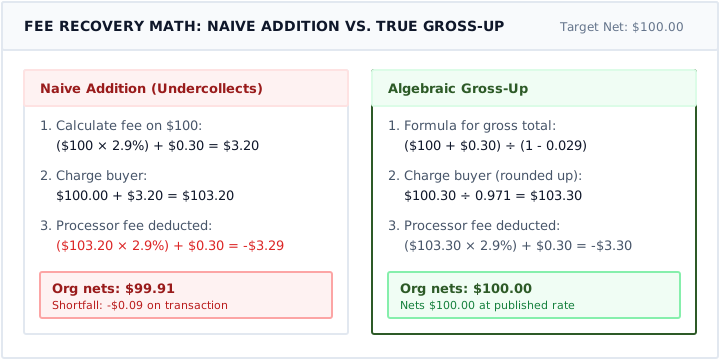
Many treasurers use simple addition to calculate fee recovery. That naive approach undercollects on every transaction because payment processors calculate their percentage fee on the final charged amount, not your starting subtotal.
Why naive addition undercollects
Suppose your organization wants to net $100.00 from a card payment. Your payment processor charges standard online pricing: 2.9% plus $0.30 per transaction.
If you calculate the fee naively:
- Multiply $100.00 by 2.9% = $2.90.
- Add the $0.30 fixed fee = $3.20.
- Charge the supporter $100.00 + $3.20 = $103.20.
When the charge processes, the payment processor takes 2.9% of the full $103.20 ($2.99) plus the $0.30 fixed fee, totaling $3.29.
Your organization receives:
$103.20 - $3.29 = $99.91
Your group is short by $0.09. On a single $100 order, nine cents seems small. Across $10,000 in payments, that shortfall loses about $9 because you paid a processing fee on the fee itself.
The algebraic gross-up formula
To net your target amount at published rates, calculate the gross charge algebraically.
Use this formula:
P_gross = (P_net + F) / (1 - r)Where P_net is the target net amount, r is the processor percentage rate as a decimal (2.9% = 0.029), and F is the fixed transaction fee ($0.30):
P_gross = ($100.00 + $0.30) / (1 - 0.029) = $100.30 / 0.971 = $103.2956Rounding up to the nearest cent ($103.30) covers the published rate:
- Charge the supporter: $103.30.
- The processor deducts 2.9% of $103.30 ($3.00) plus $0.30 = $3.30.
- Your organization nets $100.00 at the published rate.
The two-fee gross-up composition
When a software platform charges its own platform fee on top of credit card processing, the gross-up requires a two-step calculation:
- Gross up the subtotal for the platform fee schedule.
- Gross up that result for the payment processor fee schedule.
This two-step sequence covers both fees at their published rates.
Published card processing rates (such as standard fees of 2.9% plus $0.30, or nonprofit rates of 2.2% plus $0.30) are estimates. Stripe’s nonprofit discount requires recognized 501(c)(3) status with the majority of payments coming from donations, which means school booster clubs selling spirit wear or wreaths typically pay standard processing rates. In addition, actual fees vary on American Express, corporate cards, or international cards. For that reason, fee coverage displayed during checkout should always be labeled as an estimate.
Tax deductibility and bookkeeping rules
When supporters cover processing fees, volunteer treasurers face questions about tax receipts and accounting records.
Is the covered fee tax-deductible for the donor?
For pure charitable donations to a qualified 501(c)(3) organization where the donor receives no goods or services, the answer is yes. Under IRS Publication 526 (opens in a new tab) and IRS Publication 1771 (opens in a new tab), voluntary payments made to a qualified charity are deductible charitable contributions under Internal Revenue Code Section 170.
When a donor gives $100 and voluntarily adds $3.30 to cover processing fees, their total tax-deductible gift is $103.30. The donor’s written acknowledgment letter should state the full $103.30 contribution.
However, this rule applies only when the fee payment is voluntary. If an organization imposes a mandatory administrative fee, that mandatory fee is a commercial service charge rather than a charitable gift.
For product sales, such as purchasing holiday wreaths or spirit wear, payments cover goods of equal fair market value. Under IRS quid pro quo rules, payments for goods are generally not deductible unless the payment exceeds the item’s fair market value. Whether a fee add-on on a purchase is deductible depends on the facts, so do not promise buyers a tax deduction, and check with your accountant on campaign disclosures.
Our guide on tracking fundraiser sales by student covers related IRS compliance rules regarding private benefit doctrines and student accounts.
Bookkeeping and IRS Form 990 reporting
Even if your group does not meet the federal Form 1099-K reporting threshold, your bookkeeping must record gross revenue and processing costs separately.
- Revenue: Record the full amount paid by the supporter (subtotal plus any covered fees) as gross revenue.
- Expense: Record merchant processing fees as a banking or fundraising expense. For groups that file the full IRS Form 990, these fees belong in Part IX (Line 11g or Line 24). 990-EZ filers report totals; 990-N filers only confirm gross receipts are normally $50,000 or less.
Recording only net deposits in your ledger makes it difficult to reconcile bank statements with processor payout reports. If your fundraiser includes physical cash and checks, our cash reconciliation guide explains how to track physical money envelopes and dual-control deposit slips.
Three paths for your board: absorb, adjust prices, or offer opt-in
When deciding how to handle processing costs, your board has three practical options.
Option 1: Absorb the fees as a cost of doing business
Many parent groups and booster clubs choose to absorb credit card fees directly.
Card acceptance tends to raise participation compared with cash-only sales. For many booster clubs, the convenience of card payments attracts enough extra orders to justify absorbing the 3% processing fee.
Option 2: Adjust your base prices slightly
If your organization sells merchandise or runs a school wreath sale, building processing costs into your catalog pricing keeps checkout simple.
For example, pricing a spirit wear hoodie at $32 instead of $30 builds in enough margin to cover card processing without surprising buyers at checkout. The limitation: cash and check buyers pay that same adjusted price, even though manual transactions carry zero processing costs.
Option 3: Offer a transparent, default-off opt-in checkbox
An opt-in checkbox gives supporters the choice to help, but remember that it still introduces an extra decision during checkout. If you use this option, keep the checkbox default-off (unchecked).
Keep the language simple: “Cover the processing fees so more of the price reaches our program.” When the supporter checks the box, display an itemized breakdown showing the subtotal, the platform fee, and the estimated processing fee before they submit payment.
In UnitTally, storefront checkout uses this approach. The “Cover the fees” checkbox renders default-off. When checked, it itemizes the platform fee and the estimated card processing fee in real time so buyers see where every dollar goes before paying.
Model your fundraiser costs in the calculator
Before your board votes on fee policies, model your campaign numbers.
Use our fundraiser fee calculator to compare platform fees, card processing costs, and estimated net payouts across your expected sales volume.
Planning your next fundraiser?
Join the waitlist to run it on UnitTally: your group’s own store, sales credited to each seller’s link, and cash and checks logged in the same ledger as card sales.
Cash and checks cost $0 in UnitTally fees. Card sales pay Stripe’s processing fee plus a UnitTally fee of no more than $20 a transaction.